Ultimate Easy No-Knead Artisan Bread: Bakery Quality Crust with 4 Ingredients (Dutch Oven Method)
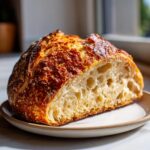
Bake bakery-style artisan bread at home using only four basic ingredients. This no-knead method requires minimal hands-on time and uses a Dutch oven to achieve a perfectly crusty exterior and a soft, airy interior.
- Prep Time: 10 min
- Cook Time: 45 min
- Total Time: 13 hours 55 min
- Yield: 1 loaf 1x
- Category: Baking
- Method: No-Knead Baking
- Cuisine: American
- Diet: Vegetarian
Ingredients
Scale
- 3 cups All-Purpose Flour
- 1 1/2 teaspoons Salt
- 1/4 teaspoon Instant Yeast
- 1 1/2 cups Cool Water
Instructions
- In a large bowl, whisk together the flour, salt, and yeast.
- Pour in the cool water and mix with a wooden spoon or spatula until a shaggy, sticky dough forms. Make sure no dry flour remains.
- Cover the bowl tightly with plastic wrap. Let the dough rest at room temperature for 12 to 18 hours. The dough will become bubbly and increase in volume.
- After the long rise, lightly flour a work surface. Gently scrape the dough out of the bowl onto the flour.
- Fold the dough over itself a few times to form a rough ball. Do not knead; just shape it gently.
- Place the dough ball on a sheet of parchment paper. Cover the bowl loosely with plastic wrap or a clean kitchen towel. Let it rest for a second proof for 30 minutes.
- About 20 minutes before the second proof ends, place your empty Dutch oven (with the lid on) into your oven. Preheat the oven to 450 degrees Fahrenheit (232 degrees Celsius).
- Carefully remove the hot Dutch oven from the oven using oven mitts. Lift the dough by the parchment paper handles and gently lower it into the hot Dutch oven.
- Cover the Dutch oven with the lid and place it back into the oven. Bake for 30 minutes.
- Remove the lid from the Dutch oven. Continue baking for another 10 to 15 minutes, or until the crust is deep golden brown.
- Carefully remove the bread from the Dutch oven and place it on a wire rack to cool completely before slicing. This cooling time develops the final texture.
Notes
- This recipe relies on a long, slow fermentation for flavor development, so plan your mixing time ahead.
- For the best crust, do not skip preheating the Dutch oven with the oven.
- If you do not have a Dutch oven, you can bake the bread on a baking stone or sheet pan, but you must create steam in the oven for the first half of the bake to mimic the Dutch oven environment.
Nutrition
- Serving Size: 1 slice
- Calories: 200
- Sugar: 0.3
- Sodium: 380
- Fat: 0.5
- Saturated Fat: 0.1
- Unsaturated Fat: 0.4
- Trans Fat: 0
- Carbohydrates: 42
- Fiber: 1.5
- Protein: 7
- Cholesterol: 0